I love my writers' group!


Me, Laura Pritchett, Karye Catrell (aka Cricket McCrae), Dana Masden

Hey all,

The night before last, my beloved Old Town Writers' Group did our annual event-- this year the theme was "Feast of Fools."  Our idea was to read stories and essays that turned the good cheer of the holidays on its head... or something like that. After hearing everyone's readings at the event (and reading my own), I realize it would've been more accurate to call it something like "Death, Destruction, and the Holidays".... Or "Murder, Mayhem, and the Holidays."  But then, we might've scared people from coming... ;)


 Sarah's husband, Travis dressed up as the "Bad Santa emcee" and did roasting-style intros... (er, don't ask about the bottle he's holding...)


If you're wondering why the  photos are blurry, it's 1) because of the current extremely messy state of my house which prevented me from locating my easy-to-operate camera in the mad dash to get out of the house on time (the priority was helping Lil Dude locate every one of his policeman costume accessories for the outing...)  and 2) because I'm the opposite of mechanically-minded-- already Lil Dude (age 4) has surpassed my abilities in this realm...

Thanks for reading! Happy weekend!

xo,
Laura  P.S.  *And nice news-- THE QUEEN OF WATER  is a School Library Journal Best Book of 2011!  Thank you, SLJ!!!*

Gratitude, mothering, and writing


Natasha Wing (fabulous picture book author), Sarah Scobey (great librarian), Laura Pritchett (talented novelist and writing group buddy) and me at the reception for Geraldine Brooks

Hi guys,

Hope you had a beautiful Thanksgiving!  We did-- we had a giant potluck dinner with old and new friends, complete with a bonfire that captivated Lil Dude.

One of the many things I'm thankful for is my amazing book-loving community of Fort Collins.  A couple weeks ago, Geraldine Brooks came to town as part of Fort Collins Reads-- this year we read her Pulitzer Prize winning book March.  

 
Geraldine Brooks (and by the way, thank you Natasha for sending me these pics!)

She was one of the most charming, smartest, wittiest speakers I've heard... although I must admit, I'm easily enchanted by accents and she had an endearing Australian one (though she now lives in Martha's Vineyard.)

 
Geraldine's rapt audience at the reception

It's always inspiring for me to hear other authors talk.... and I always learn something.  Nowadays I'm often on the lookout for good advice about how to handle being an author and the mother of a young, wildly exuberant child.

Geraldine said she has a Pavlovian-dog response to the sound of the school bus whisking her children off to school.  She makes a bee-line to her office and starts typing (or "listening to dead people" as she put it.)  When the school bus drops her kids back at home, she stops her workday and focuses completely on them.

At a reading in Boulder last month, Laini Taylor (Daughter of Smoke and Bone) told us one of her secrets of focus and productivity in the midst of little-kid-chaos: the "Freedom" app, which is now PC as well as Mac compatible!  It costs ten bucks to download, and it is so worth it. (I downloaded it that very night after I heard Laini speak). You just type in how many minutes you want to be disconnected from wireless Internet, and *Freedom* keeps you offline for that time period.  Bliss!  No distractions... I love it.  I've been SO much more productive the past six weeks. (Thanks, Laini!)

I think both Laini's and Geraldine's advice comes down to finding a way to be focused and present on the creative project at hand-- either your child(ren) or your book-in-progress or whatever else it may be.  Good to remember!

Thanks for reading!

xo,
Laura

The Magic Stick


Awesome teacher Ms. Nielsen-Drake and me with the Magic Stick! Note her gorgeous shawl from Chiapas, Mexico-- where part of my next book is set!

Hey guys!

I just got back from a fun visit to Steele Elementary in Colorado Springs... the fourth-graders read Star in the Forest and the fifth graders read What the Moon Saw. I absolutely LOVED hearing about all the connections the kids made with the books-- their interpretations and insights-- and most of all, how they took the idea of the Magic Stick (in Star in the Forest) and ran with it!  (For those of you who haven't read the book, the Magic Stick is a kind of metaphor for kindness, courage, and strength in the face of upsetting situations.)

Here's Ms. Nielsen-Drake's explanation of how the stick has become a vibrant part of her classroom!  (I changed the kids' names to first initials):

L wrote that he thought he needed a "magic stick" like Zitlally's. And then wrote, "Just kidding." I wrote back with, "Done!" And put a beautiful stick on his desk that looks like a bird's head. The stick has ended up with a life of its own in my class. Every time someone is feeling sad or in need of some comfort, he/she either asks L for it, or someone else thinks he/she needs it, and it ends up on that child's desk the next day. E's grandpa died. Someone put the stick on her desk. Today it was W's rat dying because his little brother dropped him, and so Will had the stick all day. It is SOOOOO sweet, the life that this stick has taken on! The other cool thing is that kids notice when someone, other than the "keeper-of-the-stick" L, has the stick and become very considerate and kind of that person. Isn't that amazing?

Me again: How cool is that?!  I can't tell you how much I LOVE this!  Thank you, L, for starting this tradition, and becoming the keeper of the magic stick.  And thank you to Ms. Nielsen-Drake and her amazing students for their kindness and creativity!  This is the stuff a writer's dreams are made of!

Manitou Springs

My whole trip was a treat! I stayed in the Avenue Bed and Breakfast in Manitou Springs (giant thanks to the awesome owners, Randy and Gwen, and Natalie of Black Cat Books, and the Manitou Springs Library friends and Author Fest organizers).


 Avenue B n B

Thanks to everyone involved for a refreshing and energizing author visit!

xo,
Laura

PS -- Some nice news-- The Queen of Water has been selected for School Library Journal's Best Books of 2011 list!  Yippee!  It's also on the TAYSHAS list, which is an important reading list for students in Texas!  Thank you, SLJ and TEXAS!!

You Can Never Be President (my adoption rant...)


Hi guys,


I thought that in honor of National Adoption Month, and on account of the one-year-before-the-next-presidential-election mark, I'd post this little editorial I wrote (with the intention of sending a version of it to the paper, and I still might). Okay, let me just jump on my soapbox here...

"You Can Never Be President"

When my four-year-old gives me the daily update on what he wants to be when he grows up, it usually alternates between police office, tornado fighter, and spaceman.  My response:  You'd make an awesome (fill-in-the-profession)!

I'm dreading the day he says president.  He was adopted from Guatemala at nine months, which means, as we all know from the Obama birth certificate hullabaloo, he can never be president.  I hate the thought of telling my child that although his American-born classmates can be president one day, he can't. 

My latest book, The Queen of Water, tells of my co-author's, Maria Virginia Farinango's, childhood growing up indigenous in the Ecuadorian Andes.  She was told that Indians were meant to be servants, not students.  She was told to aim for nothing higher than menial labor, that a professional career was out of the question.  She struggled against these societal messages for years, and finally, as a teenager, began to prove them wrong.  She taught herself to read.  She worked to pay her way through school.  She began her own business.  And the  ultimate triumph-- she co-authored a book about her life.

When American teens and adults read her story of injustice, they are outraged.  How can you tell a child (especially a smart, plucky little girl like Maria Virginia) that she can't shoot for her dreams?  How can you tell her that certain professions are off limits to her simply because of her heritage

But we do it here in the United States.  I'm going to have to deliver the same message to my son someday when president replaces spaceman or tornado fighter.

I'd been hoping that during the ridiculous debate about Obama's birthplace, someone would say, wait a minute, why does it matter where the guy happened to emerge from a womb?  And wait another minute, given the social changes in America over the past few centuries, why does this antiquated requirement still exist anyway!?

Thousands of infants and children are adopted internationally each year.  On arrival, they are American citizens.  In most cases they have American parents and they've lived in America most of their conscious lives.  (And although I'm focusing on adopted children here, the same argument could apply to immigrant children.)  Why should we have to tell these children they can never be president?

The majority of Americans have a personal connection to an adopted child.  We understand that families and friends consider our internationally adopted kids equal to their American-born peers.  Let's make sure that we never have to tell these children that they can't shoot for their dreams— whether they aim for police officer, spaceman… or president.

To learn more about this issue, visit http://www.equalityforadoptedchildren.org .

Thanks for reading!
xo,
Laura

The Jade Notebook page proofs...


Page proofs for JADE-- all 374 pages (with The Little Mermaid for scale...)

Hey all,

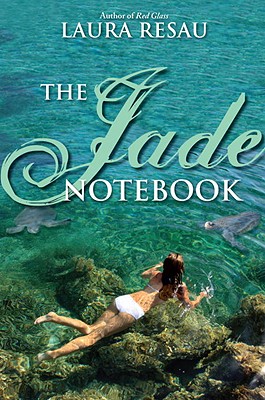
Thought I'd do a quick post to tell you that the review copies of The Jade Notebook will be out in a few weeks-- can't wait!  In the meantime, I'm going over page proofs.  This stage is so much fun-- the book finally feels like a real thing, with the final layout and font and inside design and everything. 


As I've been going over it, I'm realizing how happy I am it has a mid-February release date.  That's precisely the time of year when I get really, really, really sick of winter... and I start craving beaches and tropical waters with every freezing-cold cell of my body.  I think it'll be the perfect time-- the miserable almost-end of winter-- to be transported to a little Mexican coastal town.


Here's the epithet (is that what it's called and how you spell it? i think so...)  It has to do with one of the themes of the book-- learning to embrace the delicious mess of life.  That's something I've often struggled with. Right now, especially, I'm in the midst of lots of chaos-- living in a rental house while our house is being majorly renovated... my stuff mostly in boxes in storage, not knowing where anything is...now just waiting for that dancing star to be born...


You'll have to tilt your head to see the first page of the first chapter (click the image to make it bigger.)  Or, you could go to The Jade Notebook page that I recently added to my website for an excerpt.  (And it's available for pre-order now for e-reader and hardcover: indiebound or amazon or Barnes and Noble.)


So, I just got back from an author panel with Amy Kathleen Ryan (author of Glow).  Fascinating to hear about her journey, process, routines... and it came out that we both have backgrounds in anthropology. Here we are at the Northern Colorado Writers studio...


Okay, must drink tea and go to bed now...

Goodnight!
Laura

Using my Anthropology Background in Writing Queen


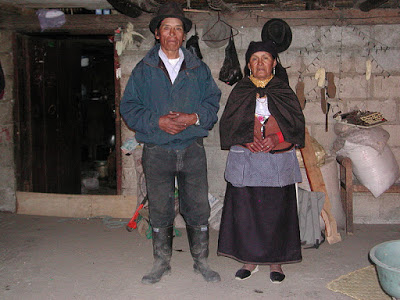
Maria Virginia's parents, 2005

Hi guys,

One question I'm often asked is how my anthropology background informs my writing.  I talked a bit about this a year or so ago in an interview with the wonderful blogger Charlotte (You can read the interview here.)

outside of Maria's parents' house

I thought it might be interesting to talk more about my anthropology background in terms of Maria's and my process of creating The Queen of Water-- the book in which I most consciously used my anthropological training.  In the initial stages, I approached this project the way I did my Master's thesis-- listening to Maria recount the story of her life (tape-recorded), asking her lots of questions along the way, and looking at her story (including the language she used) through an anthropological lens-- searching for layers of meaning-- emotional, social, cultural, etc.  (And of course, I also spent time in Maria's native village with her family and read academic books on socio-cultural issues in the Andes.)  The difference with Queen is that I could take it a step farther than my Master's thesis because Maria was an active participant throughout the entire process.  We went over every scene many times and explored these layers of meaning.  Maria is so intelligent, self-aware, and perceptive that we were able to have fascinating on-going discussions about her experiences in terms of class, gender, and ethnicity.
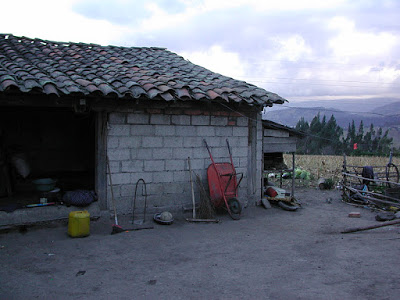
Maria's parents' house (used to be clay, now cement block)

Here's an example: She often described people in terms of their weight and skin color-- features that we talked about extensively; together, we broke down the emotional, social, economic, and cultural meanings of her descriptions.  In the impoverished indigenous community where she was born in the 1970's, it was considered beautiful to be plump, which isn't surprising considering the food scarcity. (Her village was one of the poorest in all of Ecuador.) When young Maria refers to her older sister (who left at a young age to be a maid) as plump, this is considered a good thing because it means she has more than enough food. In contrast, during Maria's early childhood, she was thin because of malnourishment and poverty.  Young Maria also describes her sister as being fair-skinned, which again, she considers a good thing, as it indicates that her sister is now part of a higher social class that doesn't have to work in the fields to earn a living.

Maria's parents' cow

Young Maria notes, with the fascination of a little girl, that the Doctorita (a mestiza) has more body fat than the women in her village.  This sets the Doctorita apart as having money and belonging to a higher social class.  But after Maria has lived with the Doctorita and started to internalize middle-class mestizo values of beauty (as seen on TV, in the exercise book, and expressed by people in town) she becomes critical of the Doctorita's weight. She sees it as a weakness, as undesirable.  As a teen, Maria's bout with anorexia is tied up with these class-related notions of weight and skin color.  She wants to become thin and pale, since that's what she perceives as culturally desirable in her new social milieu. 
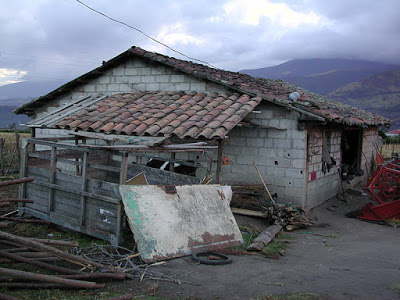
Maria's parents' house

I think that as an anthropologist and a writer, it's essential not to impose your own cultural assumptions on other societies.  And it's essential to understand that within each unique society you're dealing with, there are complex, multi-faceted, and layered meanings behind descriptions of characteristics like weight and skin color.  I was glad to have developed this perspective in my anthropology coursework and research-- I think it helped me to not take any elements of Maria's story at face value, but thoroughly explore these cultural meanings together with her... which is one reason the book took six years to write. ;)
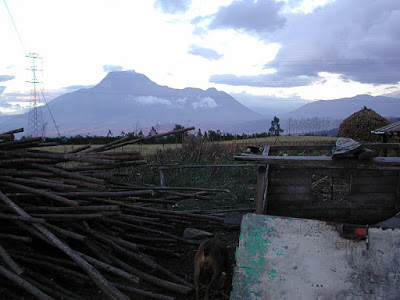

view from Maria Virginia's parents' yard

I have lots more about the process of writing Queen on my website... You can read an interview with Maria and learn which elements of her story were slightly fictionalized here.

Okay, Lil Dude keeps bursting in the room to ask if I'm ready to go to the river.... must go now!  Thanks for reading!

xo,
Laura